
You're standing in the dairy aisle, phone in hand, trying to remember whether there's still milk at home. You buy a carton just in case. Back home, you find two unopened ones at the back of the fridge, and you realise you forgot the onions you actually needed. A good grocery list fixes this, and it doesn't take long to write. You just need a routine: look at what you have, write down what you need, sort it so the shop goes quickly, and keep it somewhere everyone in the house can see it.

This guide walks you through that routine one step at a time. Once you've done it a few times, it becomes a habit that takes a few minutes a week.
What to Have Ready Before You Start
You don't need much. The point is to have everything in one place so you're not running between the kitchen and the sofa while you write.
| What | Why it helps |
|---|---|
| A list app or notepad | One place for every item |
| A quick look at the fridge | Stops you buying doubles |
| Rough plan for the week | Turns meals into ingredients |
| Your staples list | Covers the basics you always buy |
| Everyone's requests | No surprise "we're out of" later |
| Your usual store layout | Lets you sort items by section |
A few notes on the table:
- App or paper? Either works. Paper is fine if you live alone and always write the list at home. An app is more useful if you share the shopping or tend to remember things while you're out.
- A rough plan is enough. You don't need a full meal plan. Knowing "pasta twice, a stir-fry, something with the chicken" already tells you a lot.
- The store layout matters more than you'd think. If you mostly shop at one place, you already roughly know its order, for example produce near the entrance, dairy along the back wall and frozen near the end. That's all you need.
Give yourself a bit of extra time the first time. After a couple of weeks it usually goes much faster.

How to Make a Grocery List, Step by Step
Here's the routine. Each step builds on the one before, so it's worth doing them in order, at least until it feels natural.
Step 1: Check the fridge, freezer and cupboards first
Before you write a single item, open the fridge. Look for what needs using up soon: half a bag of spinach, opened yogurt, the end of a block of cheese. Then check the freezer and the cupboards for things you're running low on.
Why it matters: this is the step that stops duplicates. It's also how you notice what should shape this week's meals. If there's a bag of carrots going soft, plan a soup or a tray bake around them instead of buying more vegetables.
A quick tip: work from the top shelf to the bottom, then the door, then the drawers. A fixed order means you don't skip the crisper drawer, which is where forgotten food tends to hide.
Step 2: Sketch the week's meals
Now think about what you'll actually cook. Start with what you found in Step 1, then fill the gaps. Be honest about your week. If Thursday is always chaotic, plan something quick or leftovers, not a recipe that takes an hour.
For each meal, jot down the ingredients you don't already have. This is where a weekly grocery list really comes from: meals first, ingredients second. Shopping without a plan is how you end up with a full trolley and nothing to make for dinner.
You don't have to plan every meal. A common approach is to plan four or five dinners and leave room for leftovers, eating out or a freezer night.
Step 3: Add your staples
Staples are the things you buy again and again: bread, milk, eggs, coffee, rice, onions, toilet paper. Instead of trying to remember them each week, keep a separate staples list and run through it every time.
Why it matters: staples are easy to forget precisely because they're so routine. You notice there's no coffee at 7 am, not when you're writing the list.
To build your staples list, look back over two or three recent shops, or just walk through the kitchen and note what you'd be annoyed to run out of. Keep it short, maybe 15 to 25 items. Each week, you only tick the ones that are running low.
Step 4: Collect requests from the household
If you live with other people, ask before you shop, not while you're at the checkout. The easiest way is to keep the list somewhere everyone can add to it during the week. When someone finishes the ketchup, they add ketchup. No reminders needed.
Why it matters: it spreads the work. You're not the only one who has to remember what's run out, and you won't get surprise requests after you've already left for the shop.
Step 5: Sort the list by store section
Now take everything you've written and group it. A grocery list by category usually looks something like this:
- Fruit and vegetables
- Bread and bakery
- Meat and fish
- Dairy and eggs
- Dry goods (pasta, rice, tins, baking)
- Frozen
- Household and personal care
Put the sections in the order you walk through your store. That way you move in one direction and don't double back for the one thing you missed three aisles ago.
Why it matters: a sorted list is faster to shop from and makes it harder to forget things. When "butter" sits next to "milk" and "yogurt", you see it. When it's buried between "bin bags" and "lemons", you don't.
You could go further and order the list aisle by aisle, but simple categories already get you most of the benefit.
Step 6: Add quantities and notes
"Tomatoes" isn't very helpful when you're in the shop. "Tomatoes, 6, for the salad and pasta" is. Add how many or how much, and a short note where it matters: the brand your kid will actually eat, "ripe" for avocados you need tonight, "small" for the yogurt pots.
Why it matters: quantities stop you overbuying perishables. Fresh food bought in bulk "because it's cheaper" often ends up in the bin if there's no plan for it. Buy what the week needs.
Step 7: Share the list so nothing gets bought twice
The last step is making sure the list lives somewhere everyone can see it in real time. With a shared grocery list, when one person ticks off bread, someone else heading to a different shop doesn't buy it too. It also means whoever passes a store first can do the shop.
Paper on the fridge works if you all leave from the same place. Otherwise, a shared list on your phones is the most reliable option. What matters is that there's one list, not three versions in three heads.
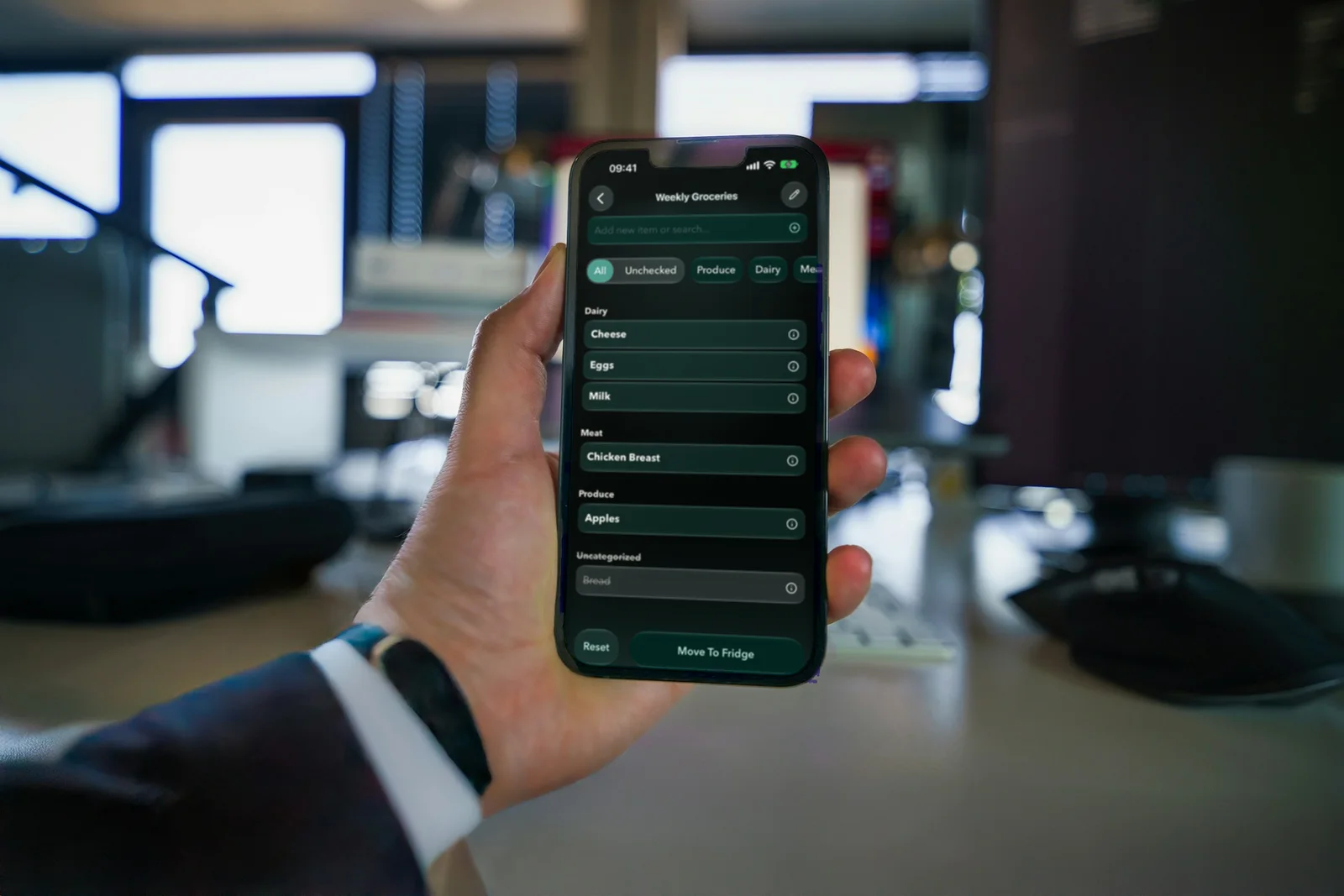
If you'd like a simple way to do Steps 1 and 7 together, Fridgea keeps track of what's in your fridge and lets you share both the fridge and your shopping lists with your household over iCloud, with no accounts. Changes show up for everyone straight away, and when a recipe needs something you don't have, it can go onto the list. If sharing is the part you need, see how family sharing works.
Common Grocery List Mistakes (and How to Fix Them)
Even with a good routine, a few things tend to go wrong. Here's what to watch for.
Writing the list from memory. It's tempting to skip Step 1 because you "know" what's in the fridge. Most of us don't, not exactly. If you're short on time, at least check the fridge door and the dairy shelf, since that's where duplicates often happen.
Planning too many meals. Seven ambitious dinners look great on Sunday. By Wednesday, plans have changed and fresh ingredients are still waiting in the drawer. Plan fewer meals than you think you need and build in one or two flexible nights.
Letting the staples list grow forever. If your staples list has 60 items, it's no longer a shortcut. Review it every month or so and remove things you've stopped buying.
Keeping several lists. A note on your phone, a sticky note on the fridge and your partner's mental list add up to confusion. Pick one place and stick with it.
Losing track of what's already been bought. If two people shop on the same day without a shared list, you get two bags of rice. Tick items off as you put them in the trolley, not after you get home.
Buying fresh food without a plan for it. Offers on big bags of salad or fruit are only good value if you'll eat them before they turn. If you're not sure, check how long the food typically keeps. Our guides on foods like eggs give typical ranges, though storage times always vary with the product, packaging and fridge temperature.
Using a template that doesn't fit you. A printed grocery list template can be a nice starting point, but most come with categories you never use. Treat any template as a draft. Cross out what doesn't apply, add your own sections, and within a few weeks you'll have one that fits your household.
Once the Shopping Is Done
The list's job isn't quite over when you get home. A few small habits make next week's list easier.
Put new food behind old food. When you unpack, move older items to the front of the shelf so they get used first. It's a simple habit, and it means less food gets forgotten.
Note what's opened and when. Opened jars, cream and cooked leftovers are easy to lose track of. Writing the date on a lid or keeping a simple food inventory helps you see what needs eating soon. When something looks or smells wrong, don't take chances: when in doubt, throw it out.
Start next week's list right away. Anything you noticed while shopping, like "nearly out of olive oil", goes onto the list now while you remember. Keep the list open during the week and add items the moment they run low.
Look back once in a while. Every few weeks, notice what keeps getting thrown away or what you always run out of. Adjust quantities, update your staples, and change the meal plan if something isn't working.
That's the whole routine: check what you have, plan a little, add your staples and requests, sort by section, and keep one shared list. It's not about being perfectly organised. It's about fewer trips back to the shop, fewer doubles in the fridge and less food going to waste.